

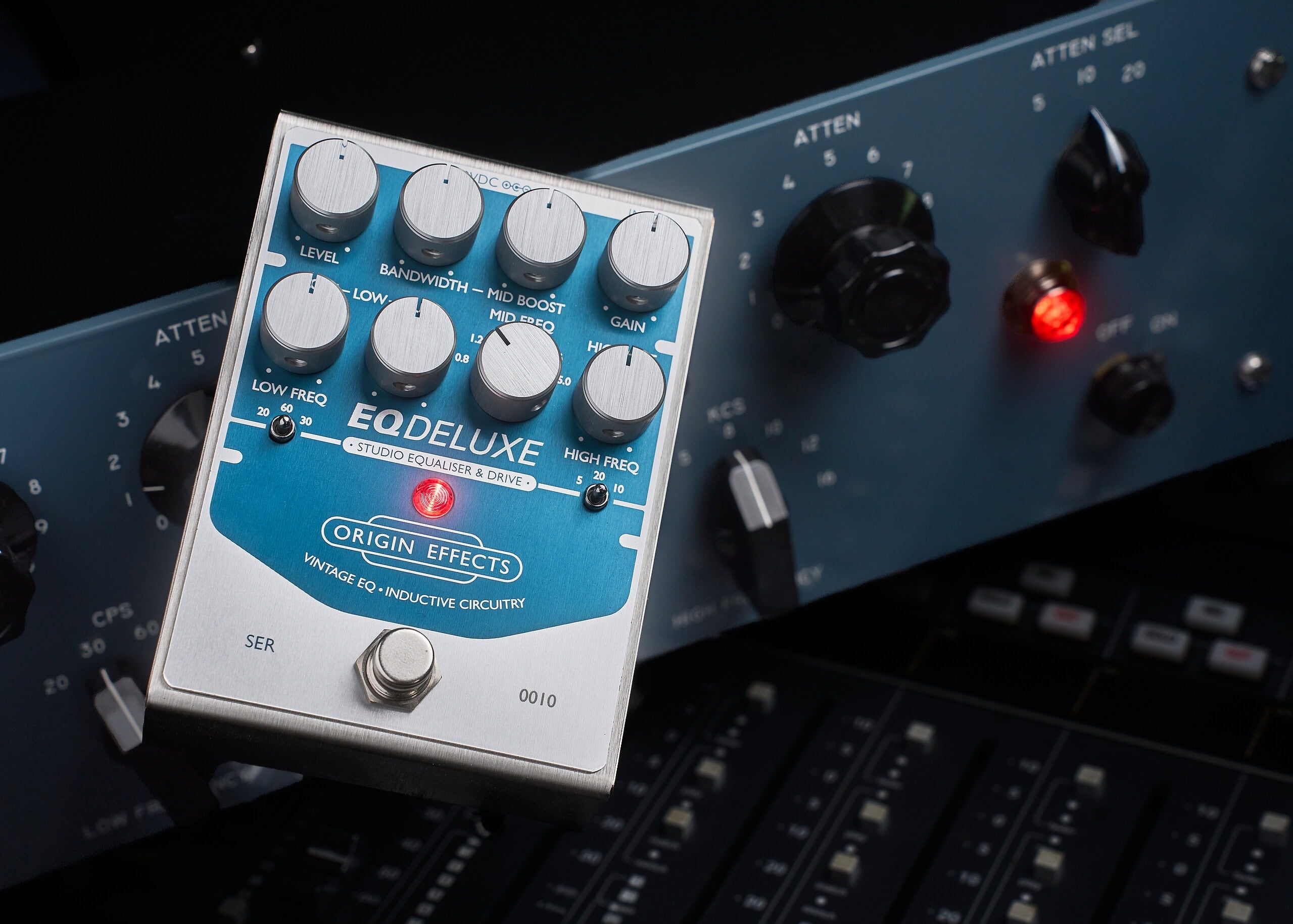
Origin Effects EQDELUXE: Pultec-style studio polish for your pedalboard
A three-band analogue EQ, a controllable saturation stage and the famous low-end trick—reworked for guitar, bass and line-level studio signals.
Why this is more than another EQ pedal
If your core tone is already good but needs more weight, presence or finished-record character, the EQDELUXE is built for that last ten per cent.
Origin Effects has taken inspiration from the 1950s Pultec EQP-1A—a passive studio equaliser known for broad, musical curves and a push-pull valve output stage—and adapted the idea into a compact, all-analogue pedal. It is not trying to be a surgical problem-solver with dozens of narrow bands. Its job is to make useful, flattering changes quickly, then add a controlled layer of harmonic character.
The result is a three-band inductive EQ tuned specifically for bass and guitar, with enough headroom to work in an amp effects loop, with a DI, or alongside an audio interface and mixing console. A high-quality buffered bypass keeps the pedalboard-facing side practical.
The short version
Think of the EQDELUXE as a character EQ and subtle drive stage: broad low-end shaping, a focused-to-wide mid boost, post-drive treble smoothing and independent control over saturation and output level.
Three bands, each doing a distinct job
Low band
Weight without wool
Separate broad BOOST and CUT controls share a 20, 30 or 60 Hz frequency selector. Use either control alone, or combine them for the Pultec trick.
Mid band
Presence and push
Boost at 0.8, 1.2, 1.6, 2.4, 3.6 or 5 kHz, then move BANDWIDTH from a sharp resonant peak to a broad, gentle bell.
High band
Polish after drive
A broad HIGH CUT at 5, 10 or 20 kHz sits after the saturation stage, making it useful for calming fizz and DI harshness.
The Pultec low-end trick, translated
On a conventional EQ, boosting and cutting the same frequency sounds pointless. Here, the boost and cut curves are different enough to create a useful composite shape: a broad bass lift plus a dip higher in the low mids. You hear more foundation, but the area that often turns into mud becomes clearer.
Select 30 Hz + raise LOW BOOST + add LOW CUT = deeper lows with a dip around 300 Hz
Origin’s manual states that the low-mid dip appears at roughly ten times the selected frequency. At 60 Hz, expect the companion dip around 600 Hz.
That interaction is the EQDELUXE’s headline feature for bass, but the 60 Hz setting can also fatten guitar while opening space around 600 Hz. The controls are broad and interactive, so small moves should be more useful than treating the knobs like an on/off recipe.
The drive is studio-style saturation, not a second distortion pedal
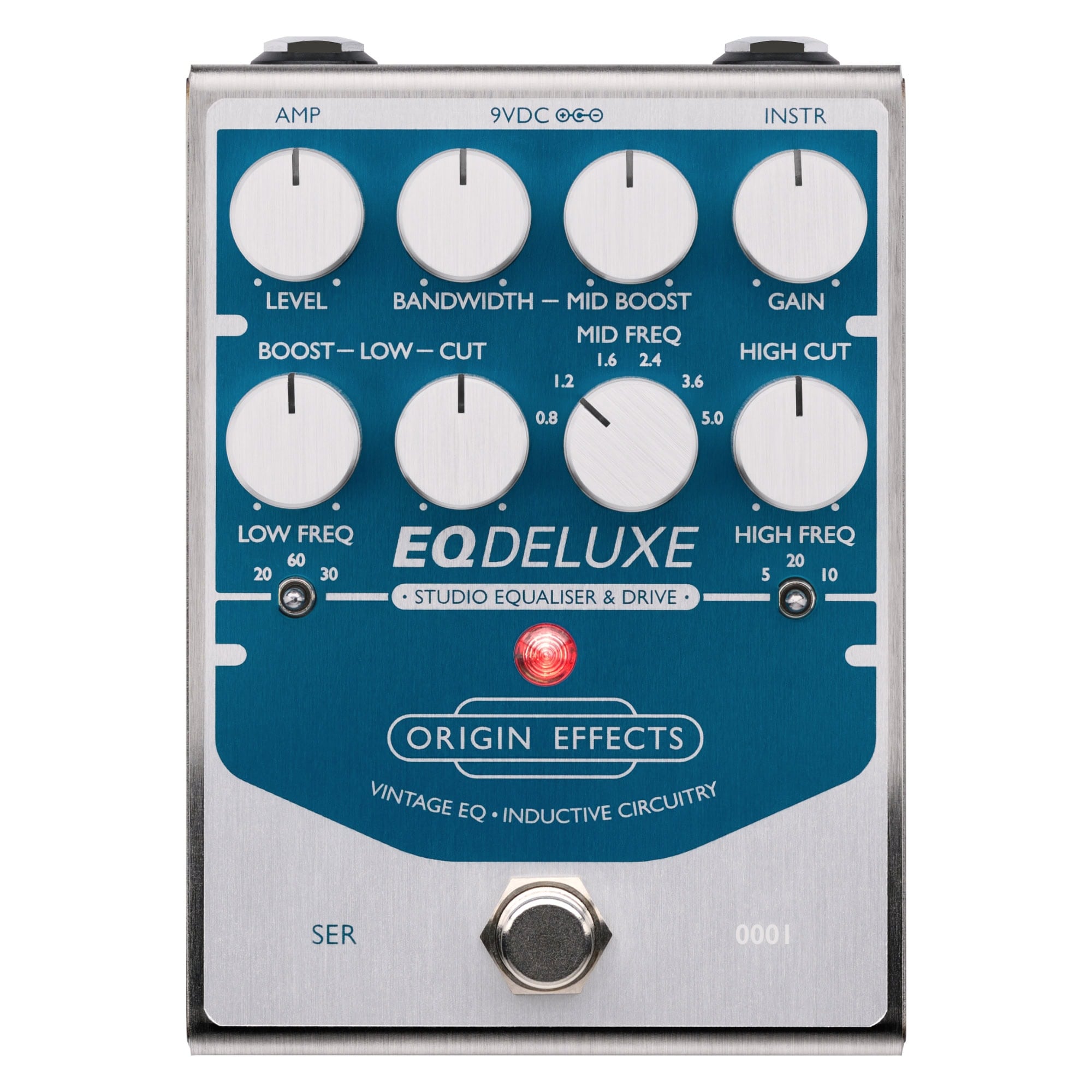
GAIN sets the character. LEVEL sets the destination.
Turn GAIN clockwise to move from maximum clean headroom into subtle push-pull-style saturation. LEVEL then sets the final output without changing that character, and offers up to 8 dB of boost at maximum. With GAIN fully anticlockwise, the manual places unity output at roughly 2 o’clock on LEVEL.
The mid band sits before the drive stage, so a strong mid boost can also push those selected frequencies harder into saturation. The high-cut circuit comes after the drive, allowing it to soften harmonics after they have been created. That internal order is especially promising for bass DI tones and guitar sounds that need texture without obvious fizz.
Where to place it in your signal chain
There is no single correct position. The important choice is whether the EQDELUXE should change how later gain stages react, or polish the sound after those stages have done their work.
Main path · shaping the drive
Guitar or bass → EQDELUXE → overdrive / preamp → amp, DI or interface
Use this when you want the low and mid controls to change the feel and clipping of the next pedal or amp. Start with modest boosts and set GAIN to taste.
Alternate path · finishing EQ
Guitar or bass → drive pedals → EQDELUXE → amp FX return, DI or interface
Use this for final tonal balance and level. Origin recommends a clean setting later in the chain for the most predictable results: GAIN low, then set LEVEL.
Setup warning: large low-frequency boosts early in the chain can overwhelm a following drive pedal or amp and make the sound indistinct. Begin near neutral, match your bypass level, and add low end gradually at playing volume.
Four practical starting points
These are starting directions based on the control ranges and Origin’s published settings—not fixed prescriptions. Match LEVEL first, then judge the EQ in the mix.
- Bass · full and clear Choose 30 Hz, blend LOW BOOST and LOW CUT, then add a broad 2.4 kHz mid boost for presence. Raise GAIN only until the line gains texture.
- Bass · retro punch Use some 60 Hz cut to tighten the bottom, boost 0.8 kHz and add mild saturation for a more forward, old-school rock voice.
- Guitar · bigger single coils Combine boost and cut at 60 Hz for warmth with space around 600 Hz, then use the 5 kHz high cut to take the hard edge off bright pickups.
- Guitar · amp-pushing mids Set a broad 0.8 kHz boost and increase GAIN slightly, using LEVEL to push an amp already near breakup without losing control of the final volume.
Origin Effects EQDELUXE specifications
The following details are verified against the official Origin Effects product page and Version 1.0 owner’s manual.
| Area | Specification | Practical meaning |
|---|---|---|
| Circuit | All-analogue, three-band inductive EQ with push-pull-inspired solid-state saturation | Characterful broad curves and controllable harmonic colour |
| Low frequencies | 20, 30 or 60 Hz; separate broad boost and cut | Deep weight, tightening, or the combined Pultec-style curve |
| Mid frequencies | 0.8, 1.2, 1.6, 2.4, 3.6 or 5.0 kHz; variable bandwidth | From warm drive emphasis to upper-mid presence and detail |
| High frequencies | 5, 10 or 20 kHz broad high cut, placed after drive | Tames fizz, pick edge and DI harshness after saturation |
| Connections | 1/4-inch TS input and output; 1 MΩ input / 1.5 kΩ output impedance | Works with guitar, bass, amp, DI and compatible studio routing |
| Power | 9 V DC, 2.1 mm centre-negative, 65 mA; adaptor only | Use a regulated pedal supply; do not run at 18 V |
| Size and weight | 123 × 86 × 58 mm; 653 g | Compact footprint, with reassuring studio-hardware heft |
| Manufacture | Designed and built in England; buffered bypass | Premium build approach with a pedalboard-friendly output buffer |
Who is the EQDELUXE for?
Bass players are the most obvious audience: the low-band interaction, subtle drive and post-saturation high cut cover several jobs normally split between an EQ, preamp and colour box. Guitarists get a flexible way to fatten bright instruments, emphasise the frequencies that push an amp, or reshape a whole drive section from one pedal.
It also makes sense for hybrid live-and-studio rigs. High headroom and separate GAIN and LEVEL controls allow it to move between pedalboard, DI and interface duties without turning into a one-setting utility.
It is less suited to players who need surgical notch filtering, multiple mid cuts, presets or MIDI control. This is a deliberately hands-on, broad-stroke analogue equaliser, and its value lies in the sound and interaction of those curves rather than the number of editable parameters.
Our early take
On paper, the EQDELUXE looks unusually well judged: it keeps the musical low-end behaviour and saturation associated with its studio inspiration, while the guitar-and-bass frequency choices and post-drive high cut solve practical pedalboard problems. The final verdict will depend on hands-on feel and sound, but the published circuit layout makes this much more interesting than a vintage-styled utility EQ.
Explore studio-inspired tone tools at Gsus4
Browse the Origin Effects range, or compare EQ and compression pedals for guitar, bass, live rigs and recording setups.
Sources & further reading
- Origin Effects EQDELUXE product page and owner’s manual
- Mixdown: Origin Effects brings 1950s studio EQ to bass and guitar players
- Gearnews: Origin Effects EQ Deluxe launch report
- Origin Effects EQDELUXE at Gsus4
Specifications and availability can change. Product imagery supplied by Origin Effects. Article prepared 29 July 2026.
Leave a comment